
Bali and Indonesia as a whole are not only known as tourist destinations but also as preferred places to live and invest for many expatriates and business owners. Living or working in Indonesia comes with tax obligations that must be fulfilled, one of which is personal income tax that must be reported through the Annual Tax Return (SPT). This article will explain who is required to report, special rules for foreigners, the latest applicable tax rates, and the reporting deadlines that need to be observed.
Who is Required to Report Income Tax in Indonesia?
Every individual who qualifies as a Domestic Taxpayer has the obligation to submit a personal income tax report through the Annual Tax Return (SPT). This obligation applies not only to Indonesian citizens but also to foreign nationals who live or work in Indonesia for a certain period of time.
Definition of Domestic Taxpayer (Tax Resident)
A person is classified as a domestic taxpayer if they meet one of the following two conditions:
- Residing in Indonesia for more than 183 days within a 12 month period, or
- Having the intention to reside in Indonesia, which is usually proven by holding an official residence permit such as KITAS (Limited Stay Permit) or KITAP (Permanent Stay Permit).
With this status, every income earned must be reported in the Annual Tax Return in accordance with tax regulations.
Taxpayer Status for Foreign Nationals
Not only Indonesian citizens, but an expatriate or foreign investor can also be classified as a domestic taxpayer if they reside in Indonesia for a long term or engage in business activities in the country. If they meet the criteria, they are required to report all income in accordance with the applicable regulations. (Source: Directorate General of Taxes Law No. 17 of 2000)
Income Tax Obligations for Taxpayers
For anyone who holds the status of a Domestic Taxpayer, whether an Indonesian citizen or a foreign national residing in Indonesia, there is an obligation to report and pay income tax. This obligation is inseparable from the fundamental principles of the Indonesian taxation system, which emphasize transparency and compliance. Therefore, it is important to understand the specific responsibilities that apply to every taxpayer.
Reporting Global Income
One of the main obligations is reporting all income earned, both from within Indonesia and abroad. Indonesia applies a worldwide income system, which means global income must be included in the Annual Tax Return.
Exemption for Foreign Nationals under the Omnibus Law
However, there is a special provision for foreign nationals. Under the Job Creation Law (Omnibus Law), foreign nationals with certain expertise who are becoming Domestic Taxpayers for the first time are granted special treatment. For the first four years, they are only required to report and pay tax on income sourced from Indonesia.
By understanding these basic obligations, the next step is to learn about the personal income tax rates in Indonesia, as these rates determine the amount of tax that must be paid each year.

Personal Income Tax Rates in Indonesia
After understanding the reporting obligations and the subjects of taxation, the next step is to learn about the applicable tax rates. In Indonesia, personal income tax rates are regulated through a clear system, which consists of progressive rates and final rates for certain types of income. Understanding these rates is important so that each taxpayer can accurately calculate their tax obligations.
Progressive Income Tax Rates
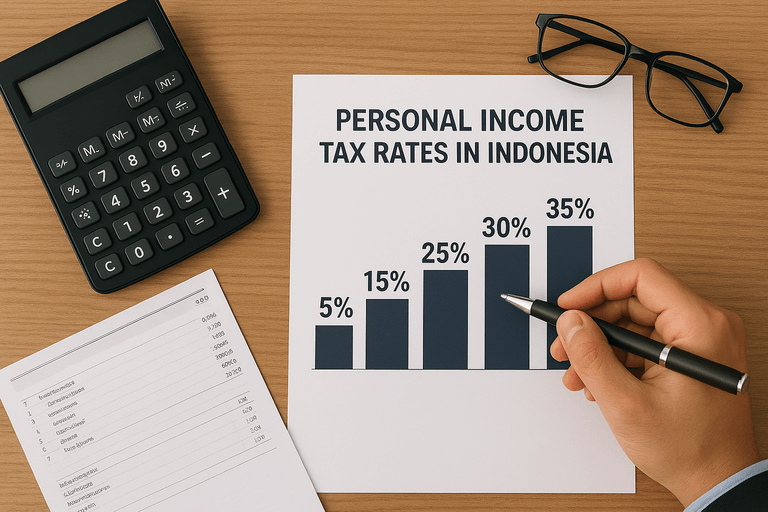
Progressive rates mean that the higher a person’s income, the greater the percentage of tax imposed. Based on the Law on the Harmonization of Tax Regulations (UU HPP), which has been in effect since the 2022 tax year, the progressive rates for individual domestic taxpayers are as follows:
- Taxable income up to IDR 60 million: 5%
- IDR 60 million – IDR 250 million: 15%
- IDR 250 million – IDR 500 million: 25%
- IDR 500 million – IDR 5 billion: 30%
- Above IDR 5 billion: 35%
This rate structure reflects the principle of fairness, where taxpayers with higher income bear a greater tax burden.
Final Rates for Certain Types of Income
In addition to progressive rates, there are also final rates that apply to specific types of income. These final rates are special and are not combined with other income in the Annual Tax Return calculation. Some examples include:
- Final income tax of 0.5% of turnover for MSME taxpayers with annual turnover up to IDR 4.8 billion.
- Final income tax of 10% on lottery prizes.
- Final income tax of 2.5% on income from certain construction services.
With these final rates, tax calculation becomes simpler because the tax is directly withheld from specific types of income without having to follow the progressive scheme. (Source: Directorate General of Taxes – PPh Final)

Annual Income Tax Return Reporting
Every taxpayer, whether an individual or an entity, is required to submit an Annual Tax Return (SPT) to the Directorate General of Taxes. The SPT serves as a means of reporting income, calculating payable tax, and recording payments made during the tax year. By filing the SPT accurately and on time, taxpayers can avoid administrative penalties and maintain legal compliance. To provide a clearer picture, below is an explanation of deadlines, penalties for late submission, and the steps that need to be prepared in the reporting process.
Deadlines and Penalties for Late Submission
The Annual Tax Return for individual taxpayers must be submitted no later than March 31 of the following year. For example, income earned in 2025 must be reported through the SPT by March 31, 2026, at the latest. If the report is submitted late, the taxpayer will be subject to an administrative penalty of IDR 100,000 for individuals. In addition, if there is an underpayment, interest will be added in accordance with the applicable tax regulations.
How to File the Annual Tax Return
Filing the SPT has become easier since it can now be done online through the e-Filing service available on the official website of the Directorate General of Taxes (Source: Directorate General of Taxes). Taxpayers simply need to log in using their Tax Identification Number (NPWP) and password, then complete the form according to the applicable type of SPT. Once the form is filled in and submitted, the system will issue an Electronic Receipt (Bukti Penerimaan Elektronik or BPE) as proof that the SPT has been officially filed.
Documents Required for Reporting
To ensure a smooth reporting process, taxpayers need to prepare the following documents:
- Tax Identification Number (NPWP)
- Tax withholding slip (for example Form 1721 A1/A2 for employees)
- Reports of other income outside of salary (such as business, rental, or investment income)
- Proof of tax payment or deposit in case of underpayment
- Other supporting documents as needed, such as statements of assets or liabilities
By understanding the deadlines, the reporting procedures, and the required documents, taxpayers can file their Annual Tax Return more easily and avoid administrative penalties.
Double Taxation Agreement (DTA)
ndonesia has established Double Taxation Agreements (DTA) with various partner countries. The main purpose of a DTA is to prevent double taxation on the same income, so that taxpayers are not burdened with paying taxes twice, both in Indonesia and in their home country (Source: Directorate General of Taxes – Tax Treaty). In addition, DTAs provide legal certainty and promote a more conducive investment climate.
In practice, there are two common mechanisms applied in the implementation of DTAs, namely tax credit and exemption.
Tax Credit Mechanism
The tax credit mechanism allows taxes paid abroad to be credited (recognized) as a deduction from the tax payable in Indonesia. This means that if a taxpayer has already paid income tax in the source country, the amount can be taken into account when calculating tax in Indonesia, subject to the limits specified in the agreement.
A simple example: an individual from Indonesia earns income from a DTA partner country and has already been taxed in that country. When filing the Annual Tax Return in Indonesia, the tax paid abroad can be recognized as a tax credit, thereby reducing their domestic tax liability.
Exemption Mechanism
Unlike the tax credit, the exemption mechanism provides an exclusion for certain types of income from taxation in Indonesia. With this mechanism, income that has already been taxed in the partner country is no longer taxed in Indonesia, ensuring it is only taxed once.
The exemption generally applies to certain types of income such as dividends, interest, or royalties, depending on the terms of the applicable DTA between Indonesia and the relevant partner country. This mechanism gives investors assurance that their income will not be subject to double taxation.
Conclusion
Understanding the rules of personal income tax in Indonesia is an important step for every individual and expatriate living or working in Bali or other regions of Indonesia. From knowing who is required to report, the obligation to declare global income, exemptions for certain foreign nationals, to understanding progressive and final rates, all of these help taxpayers calculate and report their taxes accurately. Proper filing of the Annual Tax Return and making use of DTA mechanisms can prevent double taxation while providing legal certainty.
To simplify the reporting process, Bright Solution is ready to assist with every step. Our team will help prepare the necessary documents and ensure that your personal Annual Tax Return submission runs smoothly and in accordance with applicable regulations. Contact our Tax Consultation Service to receive professional guidance and support.